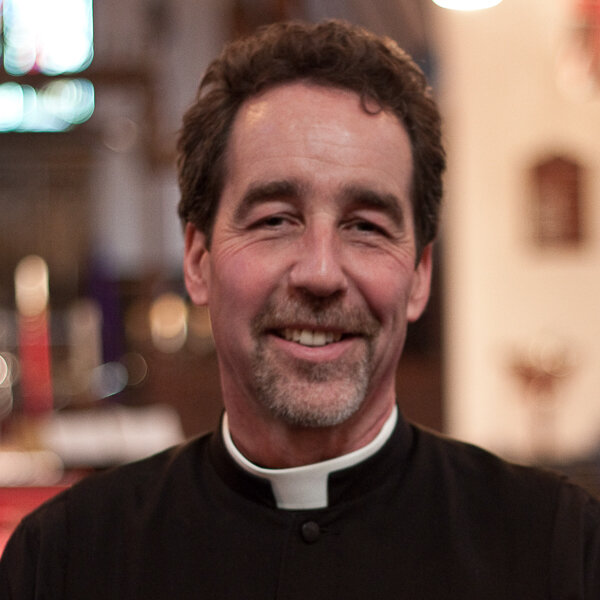
Now that I have retired from full-time ministry, I once again find myself in a place where I’m sure many of us have all been before: wondering what my identity is now that a large part of my life isn’t the same as it was for quite a long time. In thinking about my priestly identity, I look at what’s ahead of me and ask: what’s new, what’s different, and what am I now learning in this new stage of my life? To answer this, I must reflect on the different moments in my life which have led to where I am now.
I’m pushing toward my 40th anniversary in ordained ministry, all of it served here within the Diocese of Rupert’s Land. Ordained a deacon in 1987 upon my graduation from Trinity College, Toronto, and then priested the following year, I spent the first two years of ordained ministry at St. Paul’s Church, Fort Garry, under the careful tutelage of Canon David Pate. I always thought that David’s great skill in mentoring curates was that he would let you try things and flex your pastoral muscle right up to the moment at which you were going to tip off the ministerial cliff, at which point he’d tug on the rope you didn’t even realize he had tied to your ankle, and say, “Uh… let’s rethink that.” It was a brilliant way to begin to sort out what it meant to be in ministry, which is entirely different from the kind of learning about ministry one does in theological college.
From St. Paul’s I moved to Marymound, where I spent six years serving as the pastoral care worker in a setting I knew very well, having worked there as a front-line youth care worker for a couple of years prior to heading to Toronto for my theological studies. This stretch at Marymound was followed by three years as the Chaplain and Dean of Residence at St. John’s College, at the end of which I had lunch with David Pate to reflect on “next steps” in ministry. David was frank, saying that if I had any interest in parish ministry, I should make that move sooner rather than later, otherwise I might end up in institutional spiritual care for the remainder of my ministry. Not that this would be a bad thing, David insisted, but I might not want to close the door on parish ministry. And he was right.
Shortly thereafter, I submitted an application to the Parish of St. Bede, at that point in a shared building and shared worship agreement with St. Stephen’s Lutheran Church. Over the next few years, we worked to merge the two into “The Church of St. Stephen and St. Bede,” which caught the attention of both Anglican and Lutheran church leadership from across the country. My six years spent with that community were grand, yet a new idea had begun to simmer in my imagination; a dream, really, that would slowly crystallize to become saint benedict’s table. Tag-lined as being “rooted in an ancient-future,” saint benedict’s table owed a huge debt to the thought of Robert Webber and to a set of innovative thinkers of the early 2000s who had begun exploring the idea of a new or “emergent” expression of church.
And yet for all that these new ideas enlivened me, I also knew that my formation and my foundational leanings were quite profoundly orthodox. I had, after all, studied under Fr. Eugene Fairweather at Trinity College, spent two years worshipping and assisting in an Anglo-Catholic parish in my neighbourhood in Toronto, and am now active in the Parish of St. Michael and All Angels. For all of the innovations that we developed at saint ben’s, we were yet very much rooted in the great tradition and attentive to the power of orthodoxy.
And guess what? It was the right sort of improvisation for the day. As a mission parish of the diocese, we went from a gathering of twenty or so in our earliest days in 2003 to a robust community with an average attendance of a hundred and seventy in the months before the onset of the Covid-19 pandemic. Over the years, I was invited to speak in settings right across the Canadian Church, from Halifax, Nova Scotia to Victoria, British Columbia. People were excited to hear about this new church endeavour, and took some real comfort from the fact that we didn’t have to toss out the tradition; that we were, in fact, drawing deeply on the great tradition, but in a new or renewing way.
And yet, and yet. In 2008 a video documentary called One Size Fits All was released, examining the stories of ten new and different expressions of church ministry from across the country. We were one of two Anglican ministries included in the project, which was a real honour for us. It was six or eight years later that I ran into one of the people who had been behind that video project, and he was eager to hear how we were doing. “It’s good,” I told him. “We have flourished, but in a way that has never overwhelmed us.” He smiled and nodded, and then added, “You know, you are one of just three of those ministries from that film that still exists?” Oh. Wow. By the very grace of God, we have been doing something right. Lord have mercy.
Now, while we had grown to that average attendance of one hundred and seventy in 2019, COVID walloped us, as it did many communities across the country. And yes, through all of the COVID innovations into the days of reopening the church doors, there remained a vibrancy to saint ben’s such that even with numbers less than half of our old attendance in the first tentative days of gathering in those COVID years, we had a sense of possibility, of life, of vibrancy.
But in all honesty, those years had worn on me, in a way I couldn’t quite explain. Things like vestry meetings—called the Kitchen Table in saint ben’s parlance—had never been a struggle, but suddenly they were a huge burden to me. Some of the unique adult Christian education initiatives I’d coordinated for years had suddenly become more than I could even dream about. I was feeling that I was beginning to mark time, and that was something I didn’t want to do; not at all.
At the same time, Bishop Geoff Woodcroft had approached me about giving some Sunday morning assistance to the parish of St. Michael and All Angels. “Three months,” he had said to me, but it quickly became apparent that more time would be needed. In some respects, the request was simple. I was to go to celebrate the Eucharist and preach on two Sundays a month, while Fr. Brian Rountree would serve as priest-in-charge and cover the other liturgical responsibilities. The parish had hit a real low point—just twelve of us on the first Sunday I was there in July 2022—yet I knew that St. Michael’s had a unique place in the diocese, and so we needed to see if there might be a kind of renewal for the parish.
For my final year at saint benedict’s table, I would spend those two Sunday mornings each month at St. Michael’s, followed by leading the saint ben’s evening liturgies. I found myself needing to learn so much in the life of that liturgy, as while I had preached at St. Michael’s at least a dozen times over the years and celebrated the Eucharist twice, being a lead priest was something that ramped things up considerably. And now, close to four years later, I still need to turn to our organist for coaching on certain sections that I am to sing, and I have to think quite deliberately about each step of the liturgy.
But I have to say, I love being in that parish. All through the years I have loved each and every place in which I’ve been able to offer ministry, but there is something about being at St. Michael’s that really touches a part of my soul that needed some tending. As I have said, with saint ben’s I had these coast-to-coast speaking engagements—I was cast as an authority on the evolving church, and I suppose in that context I did fill that role—but where I am now is different. I’m learning. Again. I’m the relatively new guy. Again. And I’m digging into the parish history with a kind of abandon, having now volunteered to take on the role of parish archivist… and you should see the brilliantly organized archives that I have now adopted.
There’s a joy, you see, in going back to a place of learning; almost a place of innocence, I suppose. I learn every week from the clergy with whom I serve—Archdeacon Lauren Schoeck, Fr. Nicholas Saulnier, and Fr. Brian Rountree—and I trust that I offer something to each of them. I have shifted from those twenty years at saint ben’s in which I needed to know everything (a relative thing, to be sure!) into a space at St. Michael’s where I am still allowed to learn.
And in retirement, isn’t that a gift? Surely, yes. Amen and amen.