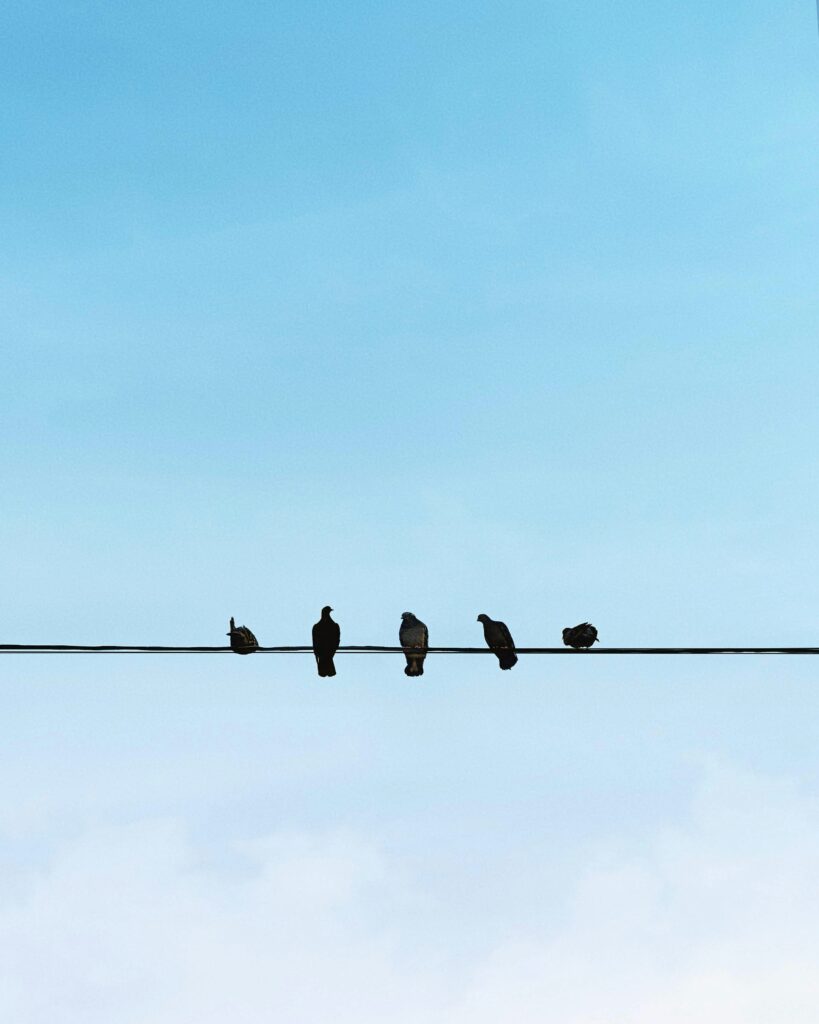
In a former parish, there was a long pew, about two-thirds of the way back from the altar, which was full each Sunday. A small group of regulars, who I thought of as ‘The Birds’, along with a changing assortment of others, would sit lined up as if on a wire. The inviting smiles, the kind inquiry about your week, and the unpretentious but devout worship drew others to these regulars, even when other pews had space. The friendship between them was obvious in their talk of intermingled lives. While not a Bird myself, I was blessed to call them friends. Witnessing their lives expanded my understanding of courage.
Well before meeting the Birds, as a child, I had a very narrow definition of courage—firefighters, police officers, and lifeguards—people who rescued others in danger. My understanding broadened as I came to learn the cost of speaking out against power and standing firm in my moral convictions. Still later, when my own marriage ended, I learned that some days it was an act of courage simply to get out of bed and face the demands of the world.
The Birds first came into my life when I worked in the office of the church we all worshipped at. One regularly drove to the church midweek to fold hundreds of pages into the weekly bulletins distributed on Sundays. We’d chat and share the highlights of our week and plans for the coming days. One week, another of the Birds invited me to her home for a visit. We spent time laughing over her photos of a giraffe sticking its head into the car through the open window and trying to eat the hat off her husband’s head. As the conversation moved on, I noticed a chair in the corner of the dining room, stacked with several rubber-banded hymnals peeking out from under some placements set atop them. Puzzled, I inquired about the books. She told me that she and her husband brought damaged books home with them after worship services, glued and repaired them, then replaced them in the pews at the church. I’d never considered what happened to the worn books before. A few years later, they made the drive from the city to my parents’ hometown almost an hour away to support me at my dad’s funeral.
Over the years, as the Birds faced the changes life inevitably brings, I consistently encountered people counting their blessings and quietly doing what they could when they saw things that needed doing. Bulletins, abandoned in pews after services, would be collected and put into the recycling bin. Those struggling nearby during worship would unobtrusively have the hymnal in their hands replaced with one opened to the correct page. Without fanfare, they gave service in the name of Christ. It was different from my approach.
When my faith had first been awakened, I had feared that ‘take up your cross and follow me’ was a command requiring the heroic sacrifice of all that made life easier. Solidarity with the disenfranchised, in my mind, meant renouncing the comforts of my middle-class life and joining them in the precariousness of their situations. The Birds provided a gentle antidote to my earnestness. They showed me that living a life of faithfulness would require as much courage as attempting to live an extraordinary life. That realization changed how I led my life.
At first it was a relief to realize I didn’t need to excel beyond others in achievement or expertise. I thought it would be easier to repeatedly take the next step. However, committing to this journey of formation and allowing myself to be changed has required more than I ever imagined.
I quickly discovered sheer willpower was insufficient—especially when I needed to forgive another. At one point I joined the staff of a small drop-in support agency to help expand their programming. For several weeks I endured snide comments, my work being undermined in conversations, and the repeated, mysterious disappearance of needed papers. I was frustrated and hurt by both my coworker’s behaviour and the board’s insistence it was our issue to resolve. I felt forced to resign. Forgiving those involved did not come naturally or easily—I felt betrayed and resented the fact I would need to start at another position. While I knew I should forgive, I refused to for several weeks. Eventually, with God’s help, I was able to take the step. It seems the true test of faithfulness is whether I’ll accept God’s help, get up, repent, and try again.
Faithfulness has also meant accepting, as gracefully as possible, decisions that aren’t mine to make. It has meant trusting family members with their own faith decisions and accepting we must each walk our own paths. While I might wish their decisions were otherwise, I’m thankful we are able to continue to be family to one another—loving each other while acknowledging and respecting our differences. Occasionally, faithfulness has required the courage to accept that some relationships break—a desire to remain friends or partners does not trump another’s wish to end things. What I can choose is to continue to love and pray for them. Love triumphs, but at the cost of a new weight in my heart.
The Birds modelled that following Christ faithfully often involves living into the uncertainty of what the future holds.
I witnessed it as health changed, deaths occurred, and homes were downsized. In my own life, the ending of my marriage, leaving jobs, and moving across the country several times have all required embracing uncertainty and saying yes to a future different from the one I’d imagined. Sometimes that stepping forth has been accompanied by excitement, but more often it is fear which predominates my emotions.
Some days, even uttering a prayer to the Creator and Sustainer of All, or trusting his promise that death isn’t the end of our story, seems to require all the courage I can muster.
The years have shown me the wisdom of the path the Birds introduced me to—a quiet courage, a faithfulness of life. I haven’t worshipped in the same parish as them for several years. Some have died. I am not certain if many continue to flock to sit together in that pew like birds on a wire. What I am certain of is that the remaining Birds continue to live lives of quiet faithfulness. I heard that one of them, having inherited furniture she had no need for, was planning to give it to a refugee family who could use it. God’s message of love continues to spread through their courageous witness. I pray the same may be said of each of us.