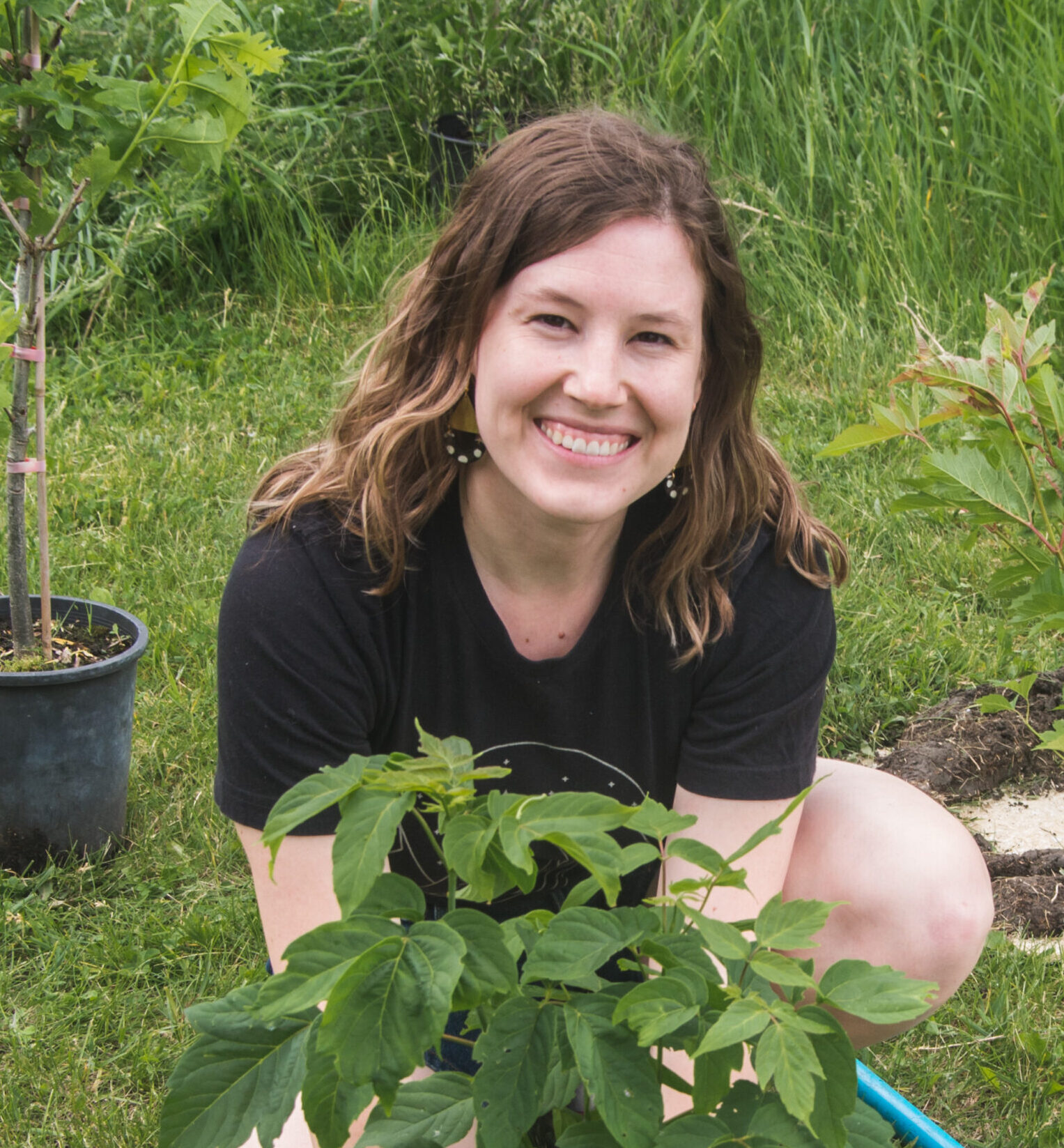

My brother, Jesse, was the kind of guy who could make friends with anyone. His unconventional perspective and non-judgmental attitude meant he could find ways to connect with others, no matter their age or their background. His inventive and creative spirit kept everyone on their toes, as he found uses for things most of us would consider garbage. He was an artist, a fixer of all things broken, and an imaginer of different worlds.
Just over three years ago, the unthinkable happened. Jesse, who was bravely battling a cancer diagnosis, had an extremely rare and adverse reaction to his treatment. While we knew this was a possibility going into the treatment, we were told the chances of a severe reaction were below one percent, and we were not prepared for this outcome. He died on December 19th, 2022, at the age of 31, three months after his son was born. I write this essay the week of what would have been his 35th birthday.
There is a stark dividing line in my life now. A before, and an after, separated by a hollowness I am still trying to wrap my mind around. When people would ask me how I was doing at that time, all I could say was, “I am trying to figure out what it means to live life in the after.” Life kept moving forward, but I was bewildered by the sudden absence of my brother’s enthusiastic presence in my future. Pieces of myself that had once felt permanent were suddenly up for debate, and I experienced a radical reorienting of everything I thought I knew about God and the world. Chimamanda Ngozi Adichie says it best in her memoir Notes on Grief: “Grief is forcing new skins on me, scraping scales from my eyes. I regret all my past certainties.”[1]
As I tried to make sense of this experience, I discovered that much popular Christian thought around suffering is filled with shallow theology and trite consolations. When faced with the unthinkable, many want to assure us that “God is in control”, or “your loved one is in a better place now,” or even “everything happens for a reason.” I know people mean well and are simply trying to be kind, but these words still rankle. They feel glib in the face of the worst thing that’s ever happened to me.
I think we offer words like these in an effort to make sense of or find meaning in a terrible experience. At a different funeral a few months ago, we sang the hymn It is Well with My Soul. I concede that the tune is moving and beautiful, but in that moment, I just wanted to yell, “No! It isn’t well with my soul! This is sad! Can you just let us be sad for a moment?!” We are often so quick to move through the desolation towards consolation. We want to skip right through Ash Wednesday, Lent, and Good Friday and get right to Easter. I wonder if this is because grief is uncomfortable and inconvenient. It points towards something that is really wrong in the world. We cannot make sense of a good God who is all-powerful, and yet allows suffering to happen, especially to good people.
One answer to this theological conundrum is that we say it was not God who brought this suffering, but it was caused by sin. When my grandmother was diagnosed with Multiple Sclerosis, a fellow church member asked her whether there was any unresolved sin in her life that had led to her illness. I can’t even imagine what must have passed through my grandma’s mind in response to this deeply uncaring question. I shudder to think she might have believed that it was her fault that she had been diagnosed with this debilitating illness.
In all my ponderings and theological meanderings, the closest I have come to an answer to the problem of evil is that it is a mystery. I recently learned that theologians have a category for this. They say that “evil is a surd,”[2] which means that it is not rational. You cannot reason with it. A surd is a mathematical term referring to an irrational number, like the square root of two. As I consider this analogy, I recall a line my parents wrote in my brother’s eulogy: “There is no explanation for Jesse’s death. No theological or philosophical reasoning does justice to the incomprehensible mystery we are facing now.” Even though this doesn’t provide me with a neat answer, I do find a strange comfort in it.
I am like Job, who, in asking God why he suffers, is not given a reason, but is told to consider creation, the storehouses laden with snow, the constellations, and the mighty leviathan. Here, God and creation are beyond human control and comprehension. Here, amidst the wildness, there is freedom from needing an answer. The suffering does not need to make sense. It just is. In creation, I observe that death is an intrinsic part of life, and there is also great beauty. I hold onto both these truths tenderly. When I do, I find that God is there alongside me and all of the groaning-singing creation.
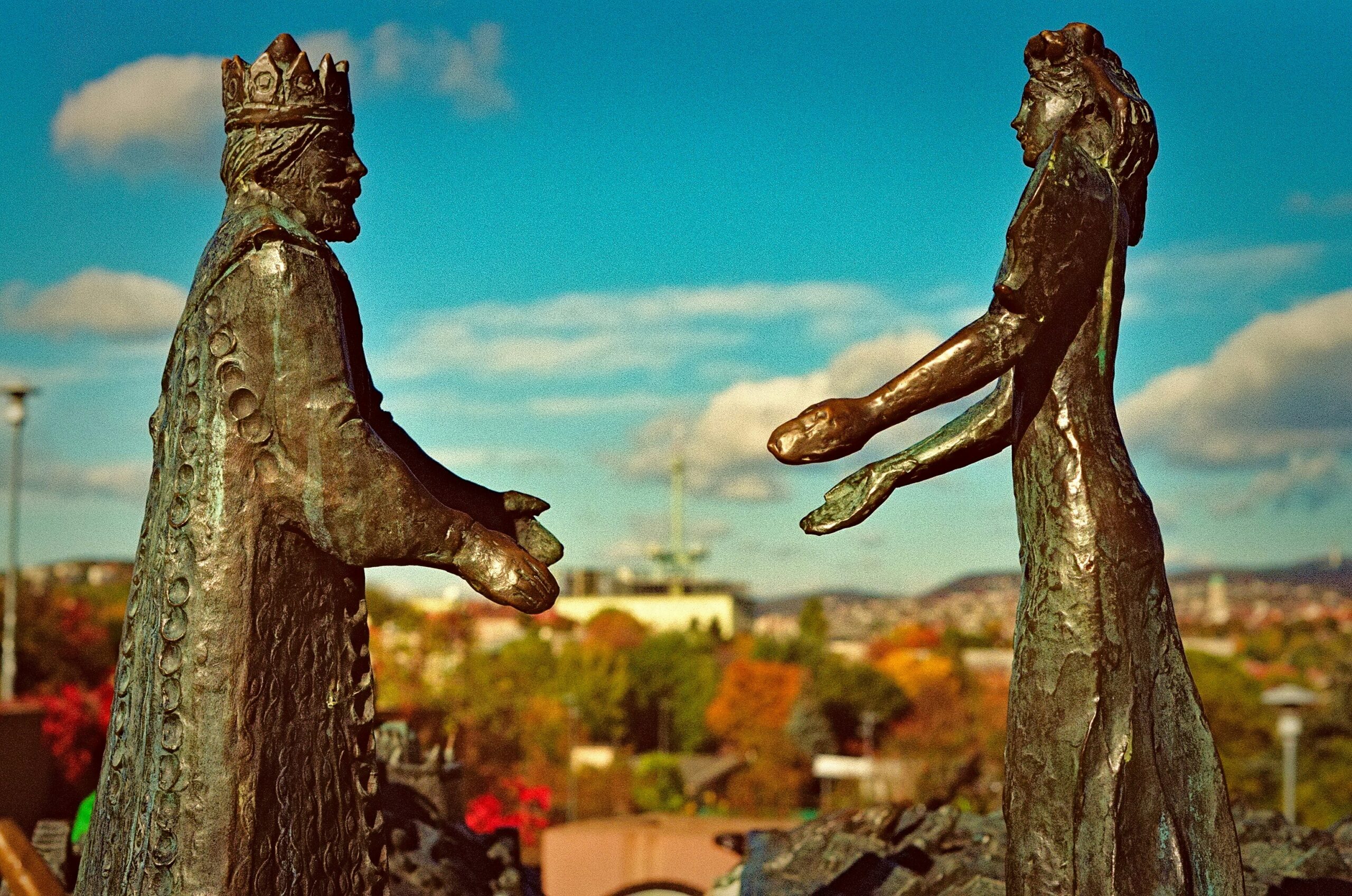
When I was in the deepest part of my grief, the responses that I found most helpful were the ones that said, “This is hard and awful, and I’m with you in this.” There’s a section in The Magician’s Nephew by C.S. Lewis where Digory confronts Aslan, asking him to heal his mother, who is sick. In despair, he gazes up to Aslan’s face and is surprised to see “great shining tears” in the lion’s eyes. “They were such big, bright tears compared with Digory’s own that for a moment he felt as if the Lion must really be sorrier about his Mother than he was himself. ‘My son, my son,’ said Aslan. ‘I know. Grief is great. Only you and I in this land know that yet. Let us be good to one another.”[3]
Like Aslan, the God who chose to become human, who experienced both the beauty and the terror of life, knows what it is to suffer, and walks alongside all those who hurt. I cannot claim to have a good answer to the question of suffering in the world. I can only tell you that in my own journey, I find solidarity with the crucified Christ—a man who wept at the tomb of his friend Lazarus, felt abandoned by friends and forsaken by God at the end of his life. The “man of sorrows… acquainted with grief”[4] sits with us in our suffering and, as the risen Christ, promises “I am with you always, even unto the end of the world.”[5]
While there may not be an explanation for my brother’s death, there is an explanation for his life. “Jesse reflected the kind heart of Jesus with everyone he met,” his eulogy concludes, “He didn’t die for a reason. But he lived for many reasons. His compassion will live on. His inventive and creative spirit will live on. His love will live on.” I hope that I can honour his memory by living out the creativity, compassion, and imagination that fuelled his life in order to accompany others in both the beauty and the terror of being alive. “Let us be good to one another,” says Aslan, or as the poet Philip Larkin puts it,
“…we should be careful
Of each other, we should be kind
While there is still time.”[6]
[1] Chimamanda Ngozi Adichie, Notes on Grief (Knopf Doubleday Publishing Group, 2021), 6.
[2] Thanks to Ryan Turnbull and his Bluesky post on Feb 16th, 2026, for this enlightening idea.
[3] C.S. Lewis, The Magician’s Nephew (Macmillan, 1955).
[4] Isaiah 53:3 (KJV).
[5] Matthew 28:20 (KJV).
[6] Philip Larkin, “The Mower” Poetry Foundation, 2001.